What a 60-Employee Functional Medicine Practice Actually Runs On
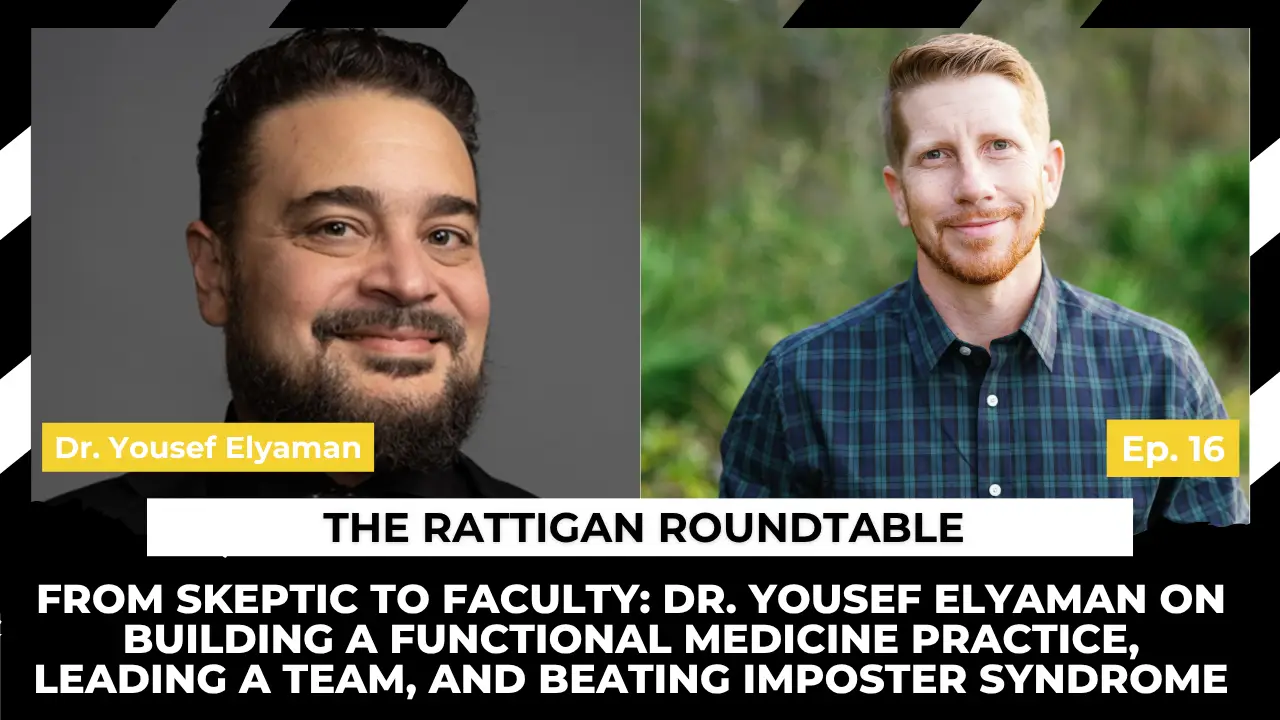
Most functional medicine providers start the same way: one doctor, one exam room, and a growing sense that conventional care isn’t solving the actual problem. Dr. Youssef Elyaman was no different. Early in his career, he was writing prescriptions for abnormal labs on patients who didn’t even feel sick yet, and it wore on him.
Everything changed with one patient. A woman with lupus and irritable bowel syndrome tried a paleo-style food plan on his suggestion. Her symptoms improved. Then her antibody markers, the lab evidence of her autoimmune disease, came back clean. That result pushed Dr. Elyaman to certify through the Institute for Functional Medicine, and he never went back to the old model.
Today he leads Absolute Health in Ocala, Florida: 8 providers, 4 health coaches, and more than 60 employees delivering integrated functional primary care. He’s also IFM faculty, medical director for Human N, director of integrative medicine at a trauma and substance treatment center, and founder of FMP Essentials, an education platform for functional medicine practitioners.
Listen to the whole conversation now:
Stop Hiring People Who Think Like You
One of the more counterintuitive lessons Dr. Elyaman shares is about hiring. Most business owners gravitate toward candidates who feel familiar, people with a similar personality or working style. He says that’s a mistake.
His office manager runs on structure and process. He runs on new ideas and creative problem-solving. That contrast isn’t a liability, it’s the reason the practice functions. He looks for three traits above all else: honesty, loyalty, and attitude. Personality fit matters less than most owners assume.
How to Handle a Mistake Without Destroying Morale
When an employee makes a mistake, Dr. Elyaman’s first move isn’t anger or swooping in with a solution; it’s gratitude. Thanking someone for bringing a problem to your attention, instead of reacting, keeps the door open for the next mistake to surface early instead of getting hidden.
From there, he asks what management could have done differently. Was there a missing SOP? An assumption that training would cover something it didn’t? Only after that does the conversation turn to the individual, and even then the focus stays on one specific, measurable behavior rather than a vague, all-or-nothing judgment.
He also flags a subtler but more pervasive risk: when leaders have to give tough feedback repeatedly, the brain shifts into a defensive mode that remembers every past mistake and forgets the good work. Naming that pattern out loud helps leaders catch themselves before a single mistake turns into a character indictment.
Imposter Syndrome Doesn’t Go Away, You Just Get a Framework for It
Even after two decades in the field, teaching for IFM, and building a large practice from scratch, Dr. Elyaman says imposter syndrome never fully disappears. What changed is how he handles the moment someone asks a question he can’t answer.
His approach: thank them for the question, admit he doesn’t know, offer to research it, and follow up. That simple formula turns a moment of exposure into a moment of credibility.
The Reminder Behind All of It
Toward the end of the conversation, Dr. Elyaman shares something more personal: a period where he was physically home with his family but mentally somewhere else, chasing the next project. Recognizing that pattern, and what it cost him, reshaped how he thinks about success.
His closing message is simple: stop measuring your life against someone else’s timeline, and stop waiting for the next milestone to enjoy the one you’re in.
Learn More about Dr. Yousef Elyaman:
Be on the lookout for Dr. Elyaman’s book, Ignite Your Healing Power, which is expected to hit stores soon.
You can find his mastermind community and podcast at FMPEssentials.com, or follow him on Instagram at @DrElyaman.
Want a head start on the paperwork that protects your practice while you grow? Grab our free guide, Five Essential Documents Every Functional Medicine Doctor Must Have, and catch the full episode on YouTube, Spotify, or Apple Podcasts.
Listen and subscribe: Spotify | Apple Podcasts | YouTube | Amazon Music
